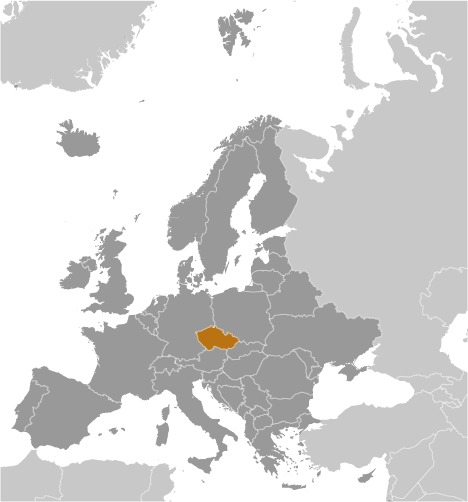
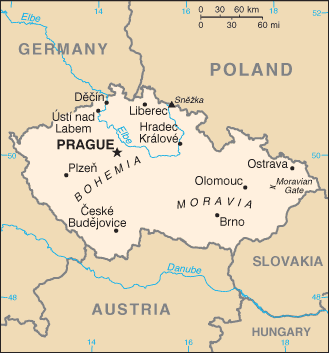
Following the First World War, the closely related Czechs and Slovaks of the former Austro-Hungarian Empire merged to form Czechoslovakia. During the interwar years, the new country's leaders were frequently preoccupied with meeting the demands of other ethnic minorities within the republic, most notably the Sudeten Germans and the Ruthenians (Ukrainians). After World War II, a truncated Czechoslovakia fell within the Soviet sphere of influence. In 1968, an invasion by Warsaw Pact troops ended the efforts of the country's leaders to liberalize Communist party rule and create "socialism with a human face." Anti-Soviet demonstrations the following year ushered in a period of harsh repression. With the collapse of Soviet authority in 1989, Czechoslovakia regained its freedom through a peaceful "Velvet Revolution." On 1 January 1993, the country underwent a "velvet divorce" into its two national components, the Czech Republic and Slovakia. The Czech Republic joined NATO in 1999 and the European Union in 2004.
Country Name
Conventional long form:Czech Republic
Conventional short form:Czech Republic
Local long form:Ceska Republika
Local short form:Cesko
Government Type
parliamentary democracy
Capital
Name: Prague
Geographic coordinates:50 05 N, 14 28 E
Time difference: UTC+1 (6 hours ahead of Washington, DC during Standard Time)
daylight saving time: +1hr, begins last Sunday in March; ends last Sunday in October
Administrative divisions
13 regions (kraje, singular - kraj) and 1 capital city* (hlavni mesto); Jihocesky (South Bohemia), Jihomoravsky (South Moravia), Karlovarsky, Kralovehradecky, Liberecky, Moravskoslezsky (Moravia-Silesia), Olomoucky, Pardubicky, Plzensky (Pilsen), Praha (Prague)*, Stredocesky (Central Bohemia), Ustecky, Vysocina, Zlinsky
Independence
1 January 1993 (Czechoslovakia split into the Czech Republic and Slovakia); note - although 1 January is the day the Czech Republic came into being, the Czechs generally consider 28 October 1918, the day the former Czechoslovakia declared its independence from the Austro-Hungarian Empire, as their independence day
National Holiday
Czechoslovak Founding Day, 28 October (1918)
Constitution
ratified on 16 December 1992, effective on 1 January 1993; amended in 1997, 2000, 2001 (twice), 2002
Legal system
civil law system based on Austro-Hungarian codes; legal code modified to bring it in line with European Union obligations and to expunge Marxist-Leninist legal theory
Suffrage
18 years of age; universal
Executive branch
Chief of state:President Vaclav KLAUS (since 7 March 2003)
Head of government:Prime Minister Jan FISCHER (since 8 May 2009); Deputy Prime Ministers Jan KOHOUT (since 8 May 2009) and Martin BARTAK (since 8 May 2009)
Cabinet:Cabinet appointed by the president on the recommendation of the prime minister
(For more information visit the World Leaders website)
Elections:president elected by Parliament for a five-year term (eligible for a second term); last successful election held on 15 February 2008 (after earlier elections held 8 and 9 February 2008 were inconclusive; next election to be held in 2013); prime minister appointed by the president
Election results:Vaclav KLAUS reelected president on 15 February 2008; Vaclav KLAUS 141 votes, Jan SVEJNAR 111 votes (third round; combined votes of both chambers of parliament)
Legislative branch
bicameral Parliament or Parlament consists of the Senate or Senat (81 seats; members elected by popular vote to serve six-year terms; one-third elected every two years) and the Chamber of Deputies or Poslanecka Snemovna (200 seats; members are elected by popular vote to serve four-year terms)
Elections:Senate - last held in two rounds on 17-18 and 24-25 October 2008 (next to be held by October 2010); Chamber of Deputies - last held on 2-3 June 2006 (next to be held by 28-29 May 2010)
Election results:Senate - percent of vote by party - NA; seats by party - ODS 36, CSSD 29, KDU-CSL 7, Open Democracy Club 6, others 3; Chamber of Deputies - percent of vote by party - ODS 35.4%, CSSD 32.3%, KSCM 12.8%, KDU-CSL 7.2%, Greens 6.3%, other 6%; seats by party - ODS 81, CSSD 74, KSCM 26, KDU-CSL 13, Greens 6; note - seats by party as of March 2010 - ODS 78, CSSD 70, KSCM 26, KDU-CSL 9, Greens 4, unaffiliated 13 (former CSSD, ODS, and Green Party members)
Judicial branch
Supreme Court; Constitutional Court; Supreme Administrative Court; chairman and deputy chairmen are appointed by the president for a 10-year term
Political Parties and Leaders
Association of Independent Candidates-European Democrats or SNK-ED [Helmut DOHNALEK]; Christian Democratic Union-Czechoslovak People's Party or KDU-CSL [Cyril SVOBODA]; Civic Democratic Party or ODS [Mirek TOPOLANEK]; Communist Party of Bohemia and Moravia or KSCM [Vojtech FILIP]; Czech Social Democratic Party or CSSD [Jiri PAROUBEK]; Green Party [Ondrej LISKA]; Open Democracy Club (a liberal parliamentary group within the Czech senate); Tradice Odpovednost Prosperita 09 or TOP 09 [Karel SCHWARZENBERG]; Union of Freedom-Democratic Union or US-DEU [Jan CERNY]
Political pressure groups and leaders
Czech-Moravian Confederation of Trade Unions or CMKOS [Milan STECH]
International organization participation
ACCT (observer), Australia Group, BIS, BSEC (observer), CD, CE, CEI, CERN, EAPC, EBRD, EIB, ESA, EU, FAO, IAEA, IBRD, ICAO, ICC, ICCt, ICCt (signatory), ICRM, IDA, IEA, IFC, IFRCS, ILO, IMF, IMO, IMSO, Interpol, IOC, IOM, IPU, ISO, ITSO, ITU, ITUC, MIGA, MONUC, NATO, NEA, NSG, OAS (observer), OECD, OIF (observer), OPCW, OSCE, PCA, Schengen Convention, SECI (observer), UN, UNCTAD, UNESCO, UNIDO, UNWTO, UPU, WCO, WFTU, WHO, WIPO, WMO, WTO, ZC
Diplomatic representation in the US
Chief of mission: Ambassador Petr KOLAR
Chancery:3900 Spring of Freedom Street NW, Washington, DC 20008
Telephone:[1] (202) 274-9100
FAX:[1] (202) 966-8540
Consulate(s) general:Chicago, Los Angeles, New York
Diplomatic representation from the US
Chief of mission:Ambassador (vacant); Charge d'Affaires Mary THOMPSON-JONES
Embassy:Trziste 15, 118 01 Prague 1
Mailing address:use embassy street address
Telephone:[420] 257 022 000
FAX:[420] 257 022 809
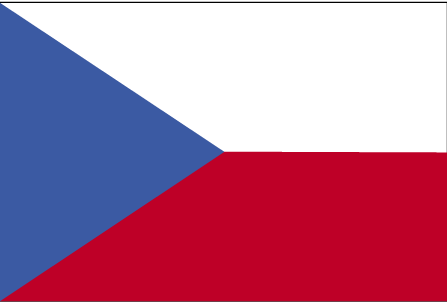
Flag description
two equal horizontal bands of white (top) and red with a blue isosceles triangle based on the hoist side
note: uses the pan-Slavic colors and is identical to the flag of the former Czechoslovakia