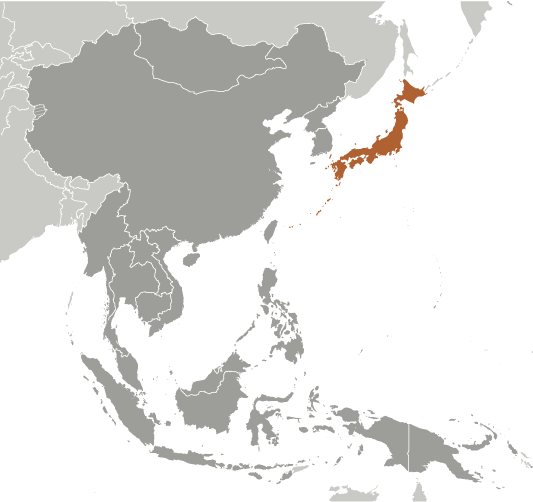
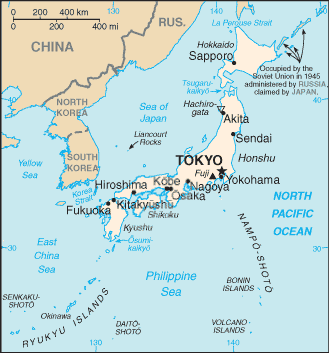
In 1603, after decades of civil warfare, the Tokugawa shogunate (a military-led, dynastic government) ushered in a long period of relative political stability and isolation from foreign influence. For more than two centuries this policy enabled Japan to enjoy a flowering of its indigenous culture. Japan opened its ports after signing the Treaty of Kanagawa with the US in 1854 and began to intensively modernize and industrialize. During the late 19th and early 20th centuries, Japan became a regional power that was able to defeat the forces of both China and Russia. It occupied Korea, Formosa (Taiwan), and southern Sakhalin Island. In 1931-32 Japan occupied Manchuria, and in 1937 it launched a full-scale invasion of China. Japan attacked US forces in 1941 - triggering America's entry into World War II - and soon occupied much of East and Southeast Asia. After its defeat in World War II, Japan recovered to become an economic power and an ally of the US. While the emperor retains his throne as a symbol of national unity, elected politicians hold actual decision-making power. Following three decades of unprecedented growth, Japan's economy experienced a major slowdown starting in the 1990s, but the country remains a major economic power. In January 2009, Japan assumed a nonpermanent seat on the UN Security Council for the 2009-10 term.
Country Name
Conventional long form:none
Conventional short form:Japan
Local long form:Nihon-koku/Nippon-koku
Local short form: Nihon/Nippon
Government Type
a parliamentary government with a constitutional monarchy
Capital
Name: Tokyo
Geographic coordinates: 35 41 N, 139 45 E
Time difference:UTC+9 (14 hours ahead of Washington, DC during Standard Time)
Administrative divisions
47 prefectures; Aichi, Akita, Aomori, Chiba, Ehime, Fukui, Fukuoka, Fukushima, Gifu, Gunma, Hiroshima, Hokkaido, Hyogo, Ibaraki, Ishikawa, Iwate, Kagawa, Kagoshima, Kanagawa, Kochi, Kumamoto, Kyoto, Mie, Miyagi, Miyazaki, Nagano, Nagasaki, Nara, Niigata, Oita, Okayama, Okinawa, Osaka, Saga, Saitama, Shiga, Shimane, Shizuoka, Tochigi, Tokushima, Tokyo, Tottori, Toyama, Wakayama, Yamagata, Yamaguchi, Yamanashi
Independence
660 B.C. (traditional date of the founding of the nation by Emperor JIMMU; first recognized by Emperor Meiji in 1873)
National Holiday
Birthday of Emperor AKIHITO, 23 December (1933)
Constitution
3 May 1947
Legal system
modeled after European civil law systems with English-American influence; judicial review of legislative acts in the Supreme Court; accepts compulsory ICJ jurisdiction with reservations
Suffrage
20 years of age; universal
Executive branch
Chief of state:Emperor AKIHITO (since 7 January 1989)
Head of government:Prime Minister Yukio HATOYAMA (since 16 September 2009); Deputy Prime Minister Naoto KAN (since 16 September 2009)
Cabinet:Cabinet is appointed by the prime minister
(For more information visit the World Leaders website)
Elections:Diet designates the prime minister; constitution requires that the prime minister commands parliamentary majority; following legislative elections, the leader of majority party or leader of majority coalition in House of Representatives usually becomes prime minister; the monarchy is hereditary
Legislative branch
bicameral Diet or Kokkai consists of the House of Councillors or Sangi-in (242 seats - members elected for fixed six-year terms; half reelected every three years; 146 members in multi-seat constituencies and 96 by proportional representation) and the House of Representatives or Shugi-in (480 seats - members elected for maximum four-year terms; 300 in single-seat constituencies; 180 members by proportional representation in 11 regional blocs); the prime minister has the right to dissolve the House of Representatives at any time with the concurrence of the cabinet
Elections:House of Councillors - last held on 29 July 2007 (next to be held in July 2010); House of Representatives - last held on 30 August 2009 (next to be held by August 2013)
Election results:House of Councillors - percent of vote by party - NA; seats by party - DPJ 109, LDP 83, Komeito 20, JCP 7, SDP 5, others 18
House of Representatives - percent of vote by party (by proportional representation) - DPJ 42.4%, LDP 26.7%, Komeito 11.5%, JCP 7.0%, SDP 4.3%, others 8.1%; seats by party - DPJ 308, LDP 119, Komeito 21, JCP 9, SDP 7, others 16 (2009)
Judicial branch
Supreme Court (chief justice is appointed by the monarch after designation by the cabinet; all other justices are appointed by the cabinet)
Political Parties and Leaders
Democratic Party of Japan or DPJ [Yukio HATOYAMA]; Japan Communist Party or JCP [Kazuo SHII]; Komeito [Natsuo YAMAGUCHI]; Liberal Democratic Party or LDP [Sadakazu TANIGAKI]; Social Democratic Party or SDP [Mizuho FUKUSHIMA]
Political pressure groups and leaders
Other:business groups; trade unions
International organization participation
ADB, AfDB (nonregional member), APEC, APT, ARF, ASEAN (dialogue partner), Australia Group, BIS, CE (observer), CERN (observer), CICA (observer), CP, EAS, EBRD, FAO, FATF, G-20, G-5, G-7, G-8, G-10, IADB, IAEA, IBRD, ICAO, ICC, ICCt, ICRM, IDA, IEA, IFAD, IFC, IFRCS, IHO, ILO, IMF, IMO, IMSO, Interpol, IOC, IOM, IPU, ISO, ITSO, ITU, ITUC, LAIA, MIGA, NEA, NSG, OAS (observer), OECD, OPCW, OSCE (partner), Paris Club, PCA, PIF (partner), SAARC (observer), SECI (observer), UN, UN Security Council (temporary), UNCTAD, UNDOF, UNESCO, UNHCR, UNIDO, UNMIS, UNRWA, UNWTO, UPU, WCO, WFTU, WHO, WIPO, WMO, WTO, ZC
Diplomatic representation in the US
Chief of mission:Ambassador Ichiro FUJISAKI
Chancery:2520 Massachusetts Avenue NW, Washington, DC 20008
Telephone:[1] (202) 238-6700
FAX: [1] (202) 328-2187
Consulate(s) general:Atlanta, Boston, Chicago, Denver, Detroit, Agana (Guam), Honolulu, Houston, Los Angeles, Miami, New York, Portland (Oregon), San Francisco, Seattle
consulate(s): Anchorage, Nashville
Diplomatic representation from the US
Chief of mission:Ambassador John V. ROOS
Embassy:1-10-5 Akasaka, Minato-ku, Tokyo 107-8420
Mailing address:Unit 9800, Box 300, APO AP 96303-0300
Telephone: [81] (03) 3224-5000
FAX:[81] (03) 3505-1862
consulate(s) general: Naha (Okinawa), Osaka-Kobe, Sapporo
consulate(s): Fukuoka, Nagoya
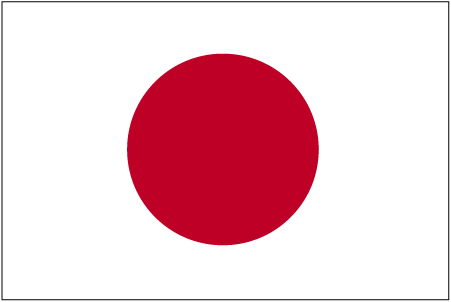
Flag description
white with a large red disk (representing the sun without rays) in the center